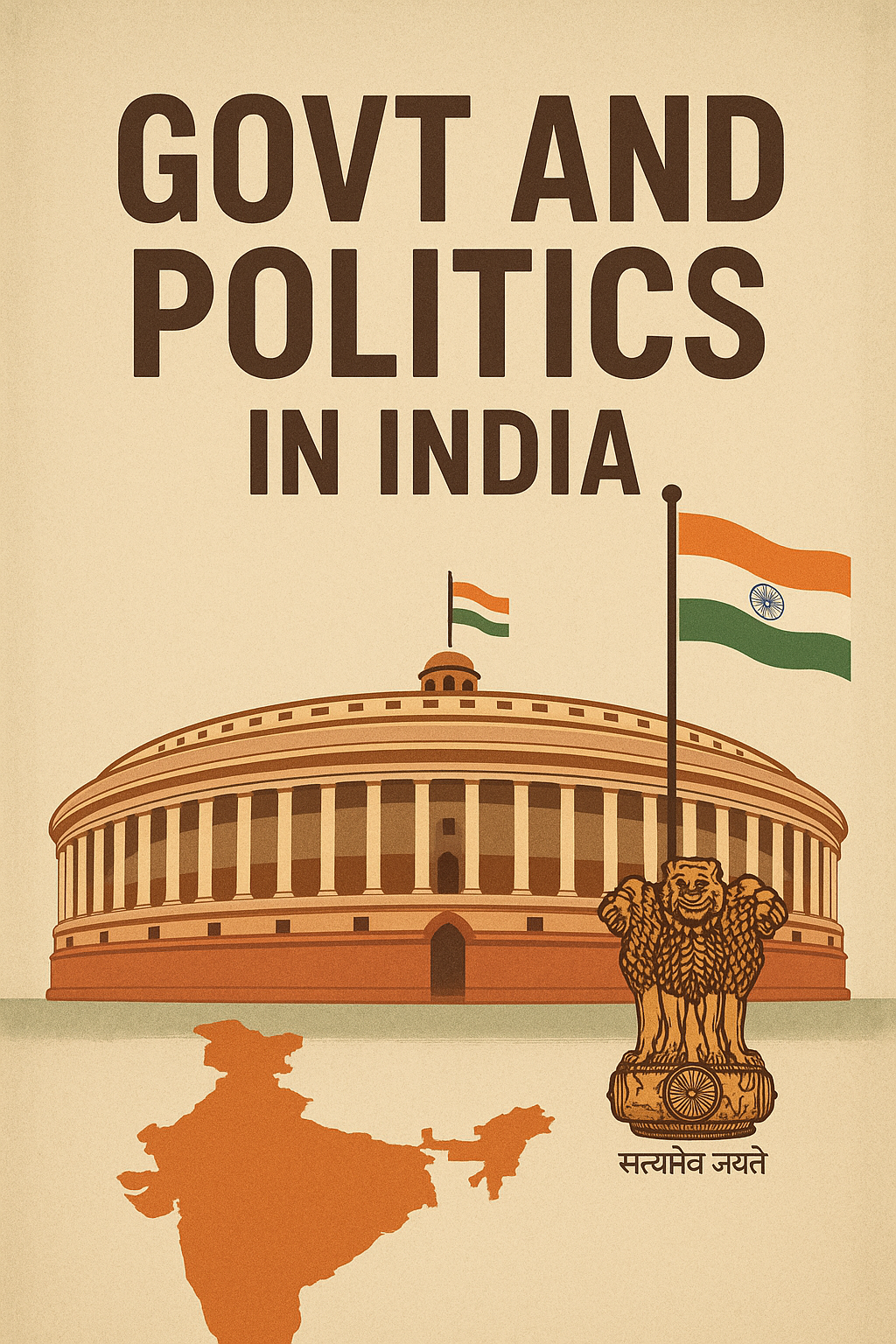
The course “Government and Politics in India: Processes” provides a comprehensive analysis of the structures, processes, and challenges shaping Indian political landscape. It begins with nature and evolution of Indian federalism focusing on the constitutional design of Centre–State relations, the evolution from cooperative to competitive federalism, and the role of institutions like the Inter-State Council and Finance Commission in managing regional diversity. The Election Commission of India is studied as a constitutional body ensuring the legitimacy of the democratic process, with attention to its autonomy, powers, limitations, and the challenges of conducting free and fair elections in a vast and diverse polity. This is followed by a discussion on electoral reforms where issues such as money power, criminalization of politics, declining voter trust, and the introduction of electronic and digital mechanisms are critically assessed alongside reform proposals recommended by various committees and commissions.
The course also investigates the role of caste, class, gender, and minorities in shaping India’s political landscape, demonstrating how social cleavages intersect with political mobilization, representation, and policy formation, while also engaging with debates on affirmative action and identity politics. The theme of secularism is explored through the lens of the Indian model, which emphasizes equal respect for all religions, while also highlighting its contestations in the context of communal tensions, minority rights, and state–religion interactions. Finally, the course addresses the transformative impact of the Liberalization, Privatization, and Globalization (LPG) model introduced in 1991, analyzing how economic reforms have restructured state–market relations, altered patterns of development, and generated new social and political challenges relating to inequality, governance, and globalization. Collectively, these themes provide a critical and holistic understanding of the functioning, adaptability, and contested nature of India’s democratic politics.
- Teacher: Muzaffar Ahmad